(Today’s post is perhaps rather more philosophical than my usual fare. I didn’t plan it that way: it’s just what came out when I started writing. Make of it what you will.)
 We begin this life utterly helpless, dependent on others to feed, clothe and teach us.
(As an aside, it’s interesting to reflect that this is the only stage of life during which we consider human beings to be ‘innocent’; it seems that loss of innocence goes hand in hand with growing awareness. It seems to me this is part of the Eden narrative: a man and a woman in a beautiful garden who seek godlike knowledge and lose their innocence as a result.)
As we grow and learn about ourselves and the world, we begin to assert our independence. Often, as part of the process of shedding our dependency on others, we develop an attachment to absolute clarity and certainty. We come to see issues in terms of black and white, and we learn to define ourselves by where we stand on politics, religion, morality and so forth. By extension, we often tend to view other people in similarly clear-cut terms, according to whether or not they agree with our rigidly defined positions. Some call this the idealism of youth; some take it to more of an extreme than others; either way, it’s probably a necessary part of the process of making sense of the world and understanding our place in it.
The problem comes when we never let go of this way of ordering the world. If we’re not careful, what began as a helpful component of the necessary transition from utter dependency to relative independence can itself become something that stunts further growth and ends up enslaving us. This happens when we never graduate beyond defining ourselves by our sharply delineated beliefs and dogmas.
Let me reiterate that, to a degree, we need such beliefs and dogmas in order to form a secure identity that will be strong enough to carry us through the unknown and turbulent waters of life. However, when we stay in this place of certainty-and-delineation-as-identity, we end up looking to no one but ourselves and our own knowledge, aptitude and performance as the ground of our security. This generally proves to be a bad move.
(We may, of course, claim and perhaps even believe that our identity and security are in God, while in reality, our belief in God is itself just another section of the scaffold we have put in place to hold up our carefully constructed self.)
One of the key ways in which we learn that we need to loosen our grip on the facts of life by which we have defined ourselves is through suffering, which in some respects is just another word for living. To put it another way, if we don’t willingly learn to live more openly and generously of heart and of mind, life has a habit of putting the squeeze on us in ways that will show us in no uncertain terms that we are not anywhere near the masters of our fate that we like to think we are.
This may all sound rather abstract, but I’m confident there’s something here that most people past a certain age will recognise in their own experience.
Like many of us, I spent years – decades even – arranging, curating and maintaining a certain way of viewing and relating to the world that felt comfortable and secure. It was, at bottom, a mode of being that allowed me to filter and process events and circumstances in such a way as to preserve my own essential rightness – and, importantly, to try to ensure that as many others as possible recognised it. It is what I still do by default, by sheer force of habit, but I’m beginning to at least lean in a different direction. However, I did not begin to let go of my certainty and dogmatism willingly or voluntarily; it took the fury of life to bring me to a place where, finally, I could no longer deny the futility of my own designs.
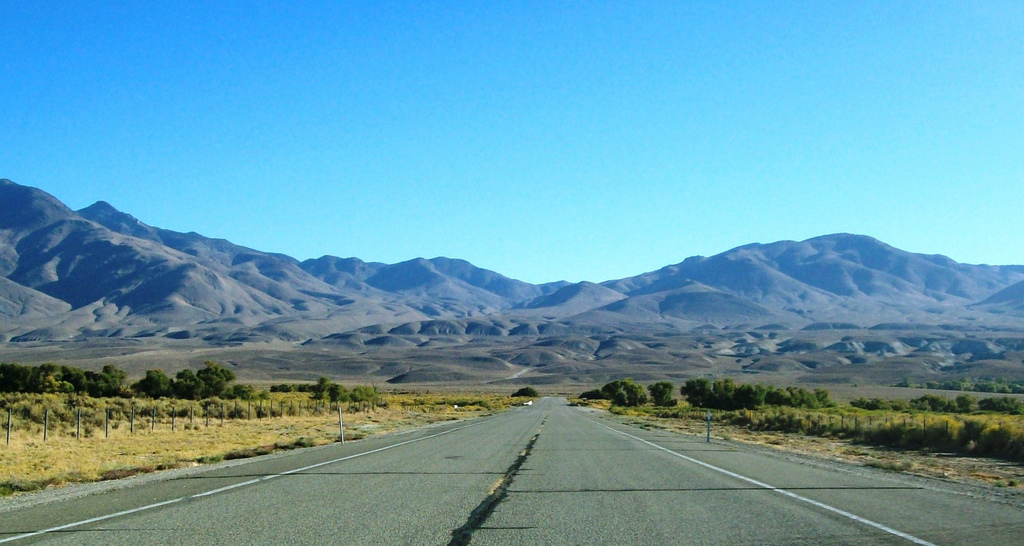
That was only the beginning of the next stage of the journey. There are still many things I am holding onto far too tightly. But I’ve turned a corner and begun to see things from a different perspective. I’m somewhere on a journey –
– from rigidly defined certainty to the embrace of doubt;
– from judgmentalism to acceptance;
– from tribal thinking to seeing the basic unity of everyone and everything.
This is not an easy journey, because it involves setting aside the map that has brought me as far as I can go and trusting someone bigger than me to lead the way from this point forward. It is, in some ways, a scary journey. But I’m coming to see that it’s also a journey from monochrome to full colour HD; in fact, more than that, it’s a journey from death to life. It’s very likely a long journey full of unknown pitfalls and dangers. But there is One with me who is unfailingly patient and who knows the way: who is, in fact, the Way, the Truth and the Life.
[ Image: mlhradio ]
