
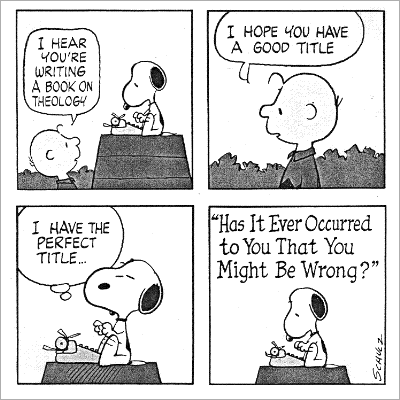
 As you may have gathered, theology is a subject that fascinates me. I’ve often thought I’d like to study for a theology qualification; maybe I will do one day if time and money permit.
One thing I’ve noticed is that many – not to say most – Christians seem to look upon theology with disdain. I often have the distinct impression that theology is widely considered as being reserved for academics and others who have nothing better to do with their time; real Christians living in the real world are more interested in getting on with their lives than in wasting time on theology.
I understand where this misapprehension comes from: like any other area of study, theology can indeed be approached as a dry and dusty academic discipline with little practical application. And there are, no doubt, too many theologians who are well-versed in their chosen field of study but have little interest in how their accumulated knowledge is worked out in the quotidian realities of life.
But let us not throw the baby out with the bathwater. It is my contention that everyone has a theology, and that what that theology is matters a great deal.
In his 1968 book In The End God, John A. T. Robinson sets out the following definition of the process of theological enquiry, which is as good a definition as any I’ve come across (emphasis added):
The Christian’s theological material is historical fact — namely a persistent community of faith owing its existence to a series of events in history interpreted as acts of God. Faced with this fact, the theologian’s first task, like that of any other scientist, is critical. He has to examine the history and documents on which this community and its faith rest, and to study the development of its life and belief. When he passes from the critical to the constructive part of his work (the department known as ‘systematic theology’), his method is equally inductive. He does not start from certain texts or creedal statements which must be accepted on faith as indisputably true, and from them spin a system of dogmatics. Rather, he begins with the Church’s life and proclamation as set out in its documents and living institutions; he examines the understanding of revelation which these presuppose; and he then seeks to formulate such general statements about God and his relation to man as will account for the facts under examination without explaining them away.
To summarise the above excerpt, theology is the attempt to describe God and his relationship to man in a way that best accounts for the data – the data in question consisting of the historical record (including the Bible and the entirety of church history) and lived experience.
The reason I bolded two sections of the above excerpt is that many Christians do indeed seem to start with certain axiomatic assumptions which must not be violated, and from which a system of dogmatics is then spun. Any attempt to question the basis of those assumptions or the doctrines that flow from them is perceived as scepticism or a lack of faith.
Of course, as a Protestant Christian, there are foundational doctrines to which I unswervingly hold, and which are well summarised in statements such as the Nicene Creed. But the reason these doctrines are foundational and non-negotiable is precisely that they have withstood the test of theological scrutiny and enquiry over centuries. They are taken as truth because they best make sense of the biblical, historical and experiential data.
When you have a community of faith that says “These things are true and must be believed without question”, you often end up with a people of shallow faith. In fact, what you sometimes end up with is a people of fundamentalist faith, which I would define as dogmatic belief that is detached from and in spite of, rather than anchored in, historical and present reality. In my experience, this kind of faith often tends to produce disciples of ideology rather than followers of Christ. And it often sets people up for great difficulty, if not full-on crises of faith, when they encounter life circumstances that their dogmatic beliefs cannot adequately account for.
I suppose one of the reasons I’m so interested in theology is that I love to ask questions and seek answers to them. Frankly, if your faith is too shaky to withstand questions, it’s not a faith I’m interested in. I believe God is more than big enough to deal with my questions, and I trust Him to guide me into all truth through His Holy Spirit. He is the God who rewards those who diligently seek Him (Hebrews 11:6), and for me, theological reading, musing and writing is one of the ways in which I do that.
