
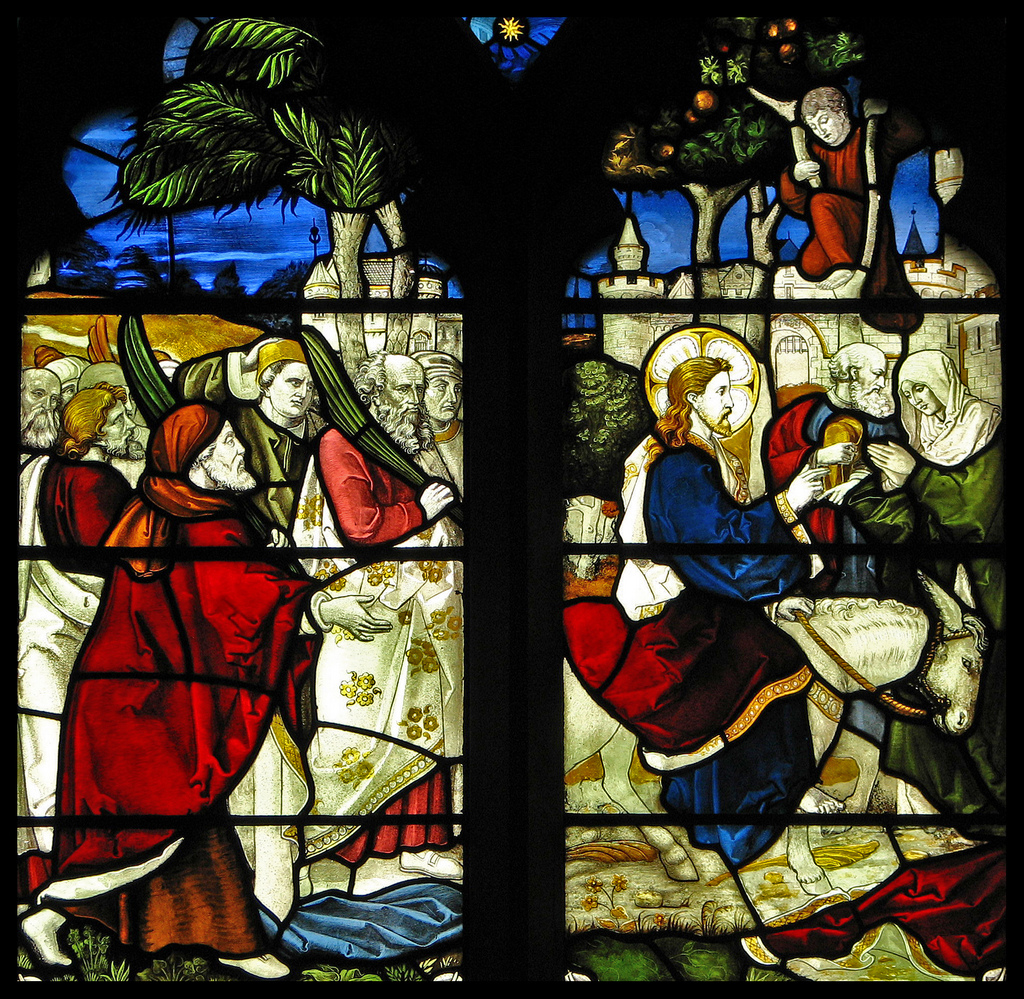
 This Sunday is Palm Sunday. Since I don’t normally post anything original on Sundays (though I will make an exception for Easter Sunday), I thought I’d offer some thoughts now.
Palm Sunday is the day when we remember Jesus’ arrival in Jerusalem, the city of God towards which he has set his face like flint, and over which he has wept. As you read the gospel accounts, you can’t help but be struck by the stark contrast between the enthusiastic welcome given to Jesus by the crowds and the building sense of impending disaster. Jesus knows the storm clouds are gathering and the long, chequered story of Israel is approaching its mysterious climax. I will not speculate on what was going through his head and his heart as he rode into the holy city on a donkey’s colt, except to say that he must have experienced a kaleidoscope of emotions.
I think of the crowd, shouting Hosanna! as they wave their palm branches and pave the way for the triumphal entry of the son of David. And I wonder how many of them will, in a few short days, be shouting We have no king but Caesar! and Crucify him!
How quickly we perform an about face when our expectations are not met; how swift we are to crucify our heroes when they fail to deliver what we assumed they were promising! For that, I believe, is the key to understanding how a jubilant and apparently adoring crowd could so quickly turn into a bloodthirsty lynch mob. They were jubilant and adoring because they wanted something; specifically, they wanted Jesus to be something particular for them.
Four hundred years since God had last spoken through the prophets, a people crushed under the weight of Roman oppression was restless and desperate for God to intervene and put an end to their suffering. They were looking for Messiah, the one who would throw off their oppressors and raise Israel once again to its former glory. Even Jesus’ closest friends and colleagues – those who had spent three years listening to his teaching and watching him visibly call this strange and mysterious new kingdom into being – could not conceive of this deliverance coming in any other way than through violent revolution.
In short, the crowd wanted a king, not to serve him but so he could serve them by giving them what they wanted: death to their enemies and glory to Israel! When it finally became clear that Jesus was never going to be that kind of king – or, in their minds, any kind of king at all – they rapidly lost interest and did what disappointed, angry mobs always do: made him into a victim, scorned, vilified, shamed, cursed and finally killed.
The challenge to us is obvious: as we hail Jesus as king, are we perhaps expecting him to be or do something for us? Is our praise contingent upon him being a good, well-behaved king and giving us what we want? And what will happen when the victory on which we had pinned our hopes does not come? Will we spit and curse in anger or turn away in disappointment?
As I wrote yesterday, the road to resurrection must first pass through Calvary. This is how God, in Jesus, becomes king: by dying a shameful, bloody death on an executioner’s cross, rejected, broken and defeated. If there were any other way, do you not think God would have chosen it?
Here, then, is the solemn invitation on the eve of this holy week: will you be quick to shout Hosanna! but then turn away when your grand hopes are not realised, or will you go with Jesus and share with him in the anguish of the garden, the humiliation of arrest and trial, the agony of torture and the final, terrible descent into death?
Jesus’ invitation to new life is first of all an invitation to the cross. There is no other way. The famous German pastor, theologian and anti-Nazi dissident Dietrich Bonhoeffer put it this way:
“When Christ calls a man, he bids him come and die.” (The Cost of Discipleship)
Will you hide in the safety of the crowd, or will you come with Jesus to the cross?
[ Image: Lawrence OP ]
